
Quick Troubleshooting Checklist
If you are short on time, run through this rapid diagnostic checklist before calling a repair professional:
No Power: Check your home’s main DB board for tripped circuit breakers and test the wall socket using a smaller appliance like a kettle.
Not Heating: Clean the lint filter and check the rear thermal reset switch if your machine has one.
Drum Not Turning: Listen closely for the motor humming; if the motor runs but the drum remains still, a snapped drive belt is likely the culprit.
Clothes Take Too Long to Dry: Inspect the exhaust vent hose for kinks, twists, or dense lint blockages that restrict airflow.
Error Lights Flashing: Consult read your user manual to check if you accidentally activated the safety child-lock feature.
Table of Contents
Durban’s high humidity makes a dependable tumble dryer an absolute necessity, especially in coastal suburbs like Reservoir Hills. When your appliance suddenly stops spinning or blowing hot air, your laundry routine can grind to a frustrating halt. However, you do not always need to call out a technician immediately. Many common tumble dryer faults stem from simple issues that you can diagnose and resolve right at home.By performing basic troubleshooting beforehand, you can quickly save yourself both time and unnecessary call-out fees. This comprehensive guide outlines the exact steps you can take to diagnose your tumble dryer before booking a professional repair service in Reservoir Hills.
Phase 1 Baseline Electrical and Power Diagnostics
By performing basic troubleshooting beforehand, you can quickly save yourself both time and unnecessary call-out fees. This comprehensive guide outlines the exact steps you can take to diagnose your tumble dryer before booking a professional repair service in Reservoir Hills.
Check the DB box
Tumble dryers pull a strong electrical current, usually between 2000 and 2500 watts. If your household is running multiple high-draw appliances at the same time your circuit breaker may trip to protect the system.
Walk over to your main DB board and find the switch marked “Plugs” or “Laundry.”
Look for a switch that has flipped halfway down or completely off.
Push the switch firmly down to reset it, then flip it all the way up.
Verify the Wall Socket Functionality
Sometimes, the issue lies within the wall plug itself rather than the tumble dryer.
Unplug your tumble dryer completely from the wall.
Plug a smaller, functional appliance—such as a hair dryer or an electric kettle—into that exact same socket.
Turn the smaller appliance on. If it doesn’t power up, you are dealing with a local electrical fault or a faulty socket, which needs an electrician rather than an appliance technician.
Turn off the Safety Child-Lock
Modern appliances feature digital safety mechanisms that stop operation if configured incorrectly. For instance, you might have accidentally triggered the integrated child-lock setting while cleaning the control panel, making the interface completely unresponsive.
Look at the display panel for a padlock symbol, key icon, or a flashing light code like “CL”.
Refer to comprehensive appliance troubleshooting steps on wikiHow’s Guide on Dryer Control Locks to learn how different systems handle resets. Typically, you hold down a specific two-button combination (like Time Delay and Buzzer) simultaneously for three to five seconds to unlock the control interface.
Phase 2: Airflow and Heating Diagnostics
Why is the lint filter important
A heavily clogged lint filter chokes the appliance’s internal circulation system. When air cannot flow freely through the drum, moisture remains trapped inside the clothes.
Pull the lint filter out from the door rim or the front housing.
Scrape away the layer of fluff with your fingers.
Wash the filter under warm water every few weeks to remove invisible film buildup left behind by fabric softeners.
Ensure the filter dries completely before you slide it back into the machine. a
Inspecting Vented vs. Condenser Systems
The method you use to clear an airflow restriction depends entirely on the design style of your tumble dryer.
For a vented machine, pull the unit away from the wall and inspect the flexible exhaust pipe. Straighten out any sharp bends that restrict the exhaust air. If you use a condenser model instead, pull out the lower condenser drawer, rinse it thoroughly in your shower or yard to clear trapped debris, and slide it securely back into place.
Phase 3: Mechanical and Drum Movement Troubleshooting
When your tumble dryer powers up and gets hot but your clothes stay bunched up in one spot, you are facing a mechanical failure.
1. Diagnosing a Snapped Drive Belt
The drive belt is a thick rubber band that loops around the motor pulley and the outer circumference of the drum. Over time, the rubber stretches, cracks, and eventually snaps.
Open the door of your switched-off tumble dryer.
Insert your hand and try to rotate the metal drum manually.
The Diagnostic Test: If the drum spins freely with absolutely no resistance, the drive belt has snapped. If you feel a firm, smooth resistance, the belt remains intact and wrapped around the motor drive shaft.
2. Testing the Door Switch Mechanism
Your tumble dryer features an internal micro-switch located behind the door latch mechanism. This switch serves as a vital safety feature, ensuring that the drum stops spinning the moment someone opens the door during operation.
Examine the plastic prong on the door frame to ensure it is not cracked or broken.
Press the micro-switch inside the latch hole with a small pen tip while the machine is on (with the door open) to see if it responds.
If the switch cannot engage mechanically, the machine’s central computer assumes the door is open, which completely prevents the drum from starting.
Lorem ipsum dolor sit amet, consectetur adipiscing elit. Ut elit tellus, luctus nec ullamcorper mattis, pulvinar dapibus leo.
Lorem ipsum dolor sit amet, consectetur adipiscing elit. Ut elit tellus, luctus nec ullamcorper mattis, pulvinar dapibus leo.
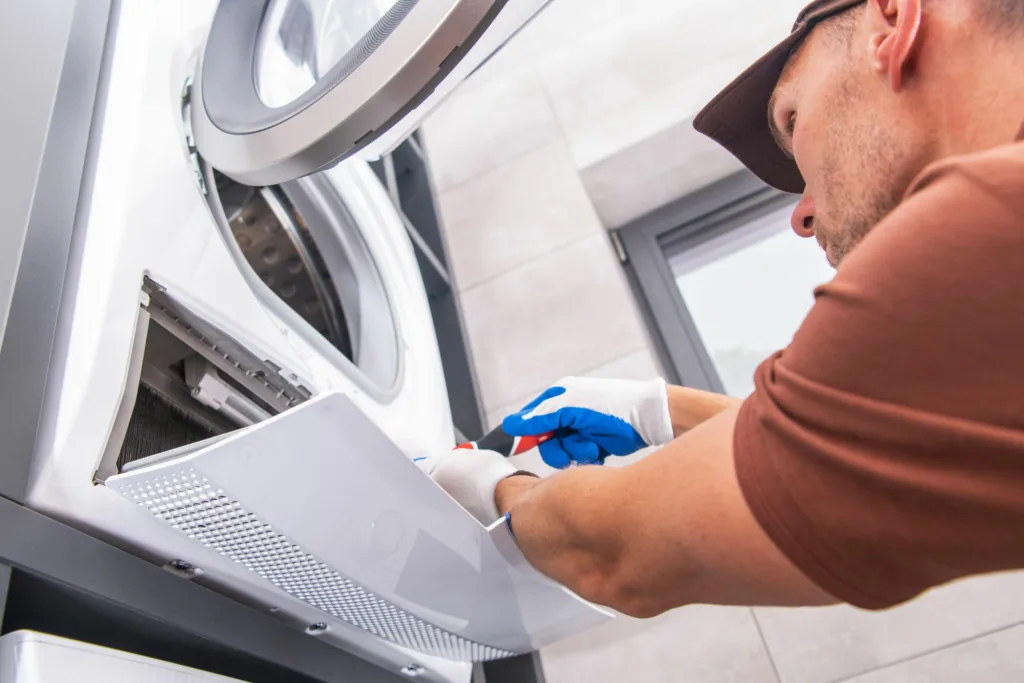
Appliance Diagnostics & Repair Action Plan
| Symptom | Likely Root Cause | Quick DIY Inspection Check | Action Level |
|---|---|---|---|
| Machine hums but drum won't rotate | Failed start capacitor or seized drum roller. | Try giving the drum a gentle manual push to assist startup. | Call Technician |
| Loud thumping or rhythmic banging | Flat spots on the drum support rollers. | Inspect the interior drum for loose coins, keys, or heavy buckles. | Call Technician |
| High-pitched squealing noise | Worn drum bearings or a dry idler pulley. | Listen to determine if the noise persists throughout the full cycle. | Call Technician |
| Water leaking from the door base | Distorted or lint-covered rubber door seal. | Wipe down the inner rubber lining with a microfiber cloth. | DIY Fix |
| Appliance trips electricity instantly | Earthed heating element or shorted motor coil. | Test the appliance on a different electrical ring circuit breaker. | Call Technician |
Disclaimer
Safety First: The information provided in this table is for general diagnostic purposes only. Unplug all electrical appliances before attempting any inspections. If the Action Level indicates "Call Technician," do not attempt a DIY fix, as this may result in injury or void your warranty.
Frequently asked questions
-
Why does my tumble dryer take so long to dry?
This extended drying time typically points directly to a severe airflow restriction. Clean your lint filter completely and inspect the external exhaust vent line for obstructions. When air cannot escape efficiently, the appliance recirculates damp air, which significantly extends the overall drying cycle.
-
Is it safe to run my tumble dryer on a standard heavy-duty extension cord?
No, you should never connect a tumble dryer to an extension cord or a multi-plug adapter. These appliances pull significant electrical current. Consequently, extension cords can overheat rapidly, melt the plastic insulation, and create a serious household fire hazard. Always plug the machine directly into a dedicated wall outlet.
-
Why does my tumble dryer smell like something is burning?
A distinct burning odor generally indicates that fine lint particles have bypassed your filter and settled directly onto the glowing heating element. Alternatively, it could mean that a worn drive belt is slipping against the motor pulley, generating intense friction heat. Turn off the machine immediately if you detect this odor.
Smart Appliance Centre team - meet the authors
For over 40 years, our Durban North-based centre has provided expert, on-site repairs for all major tumble dryers and washing machines. We offer same-day service across Durban, guaranteed workmanship, and call-outs with accepted quotes. Contact our specialists today to restore your laundry appliances.